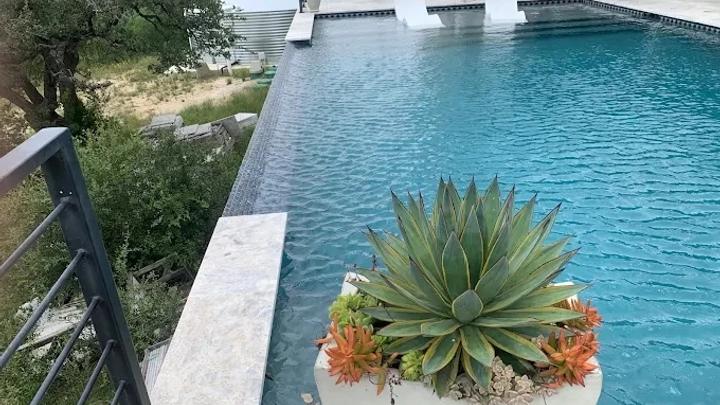
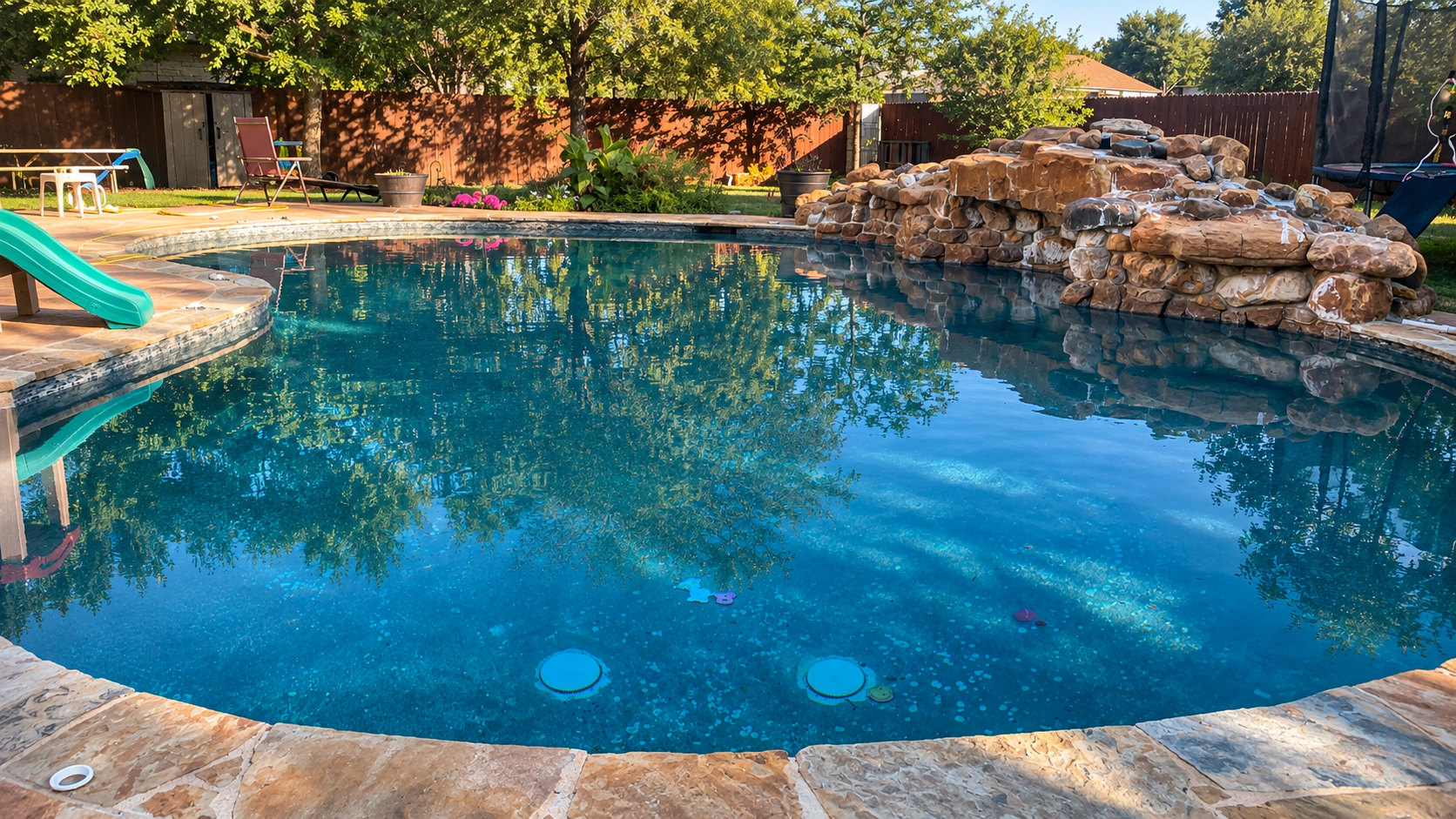
Two pools. Same week in August. Both losing about half an inch a day.
The one in Avery Ranch has a soggy strip of grass between the deck and the equipment pad. The one in Circle C has bone dry ground all the way around. Same symptom, two very different problems.
That is pool leak detection in Austin. If you are hiring pool leak detectors, you want someone who knows why those two pools leak differently. Here is how our North and South Austin teams find leaks, what it costs, and when to call.
Why Pool Leak Detection in Austin Is Two Different Jobs
Most guides treat every pool the same. Central Texas does not let you do that. Most leaks in Austin come down to the ground under the pool.
North and East Austin sit on expansive clay. Locals call it black gumbo. It swells when it rains and shrinks hard in a drought. That movement pulls on underground plumbing and cracks PVC plumbing lines at the joints. Clay is behind most of the plumbing leaks we find up north. When a return line breaks in clay, the water has nowhere to go. You often get soggy spots in the landscape, a sinking paver, or a green stripe in a dry lawn.
South and West Austin sit on limestone. Much of it is karst over the Edwards Aquifer recharge zone. The rock is full of cracks and voids. When a line breaks here, the water can drain straight down into the rock. No soggy spots. No wet dirt. Just a pool that keeps losing water and no clue where it goes.
"In Circle C or Oak Hill, a dry yard means nothing. We've found plenty of busted return lines under perfectly dry ground. The limestone just swallows the water. That's why we never guess from the surface."
So the first question we ask isn't "where's the wet spot?" It's "what is your pool sitting on?" Lakeway and Steiner Ranch add another twist, with shallow bedrock that makes digging slow and costly. That is one more reason to pinpoint the leak location before anyone picks up a shovel.
How Our Pool Leak Detectors Find Leaks Without Guesswork
Professional leak detection follows the same order every time. Good swimming pool leak detection is a process, not a guess. Skipping steps is how problems get missed.
- Confirm the water loss. Our summers mean real evaporation. We check your water level and rule out evaporation first, so you don't pay to chase a problem you don't have.
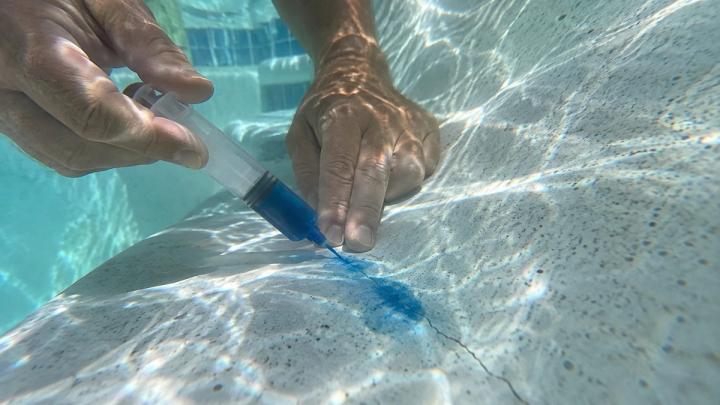
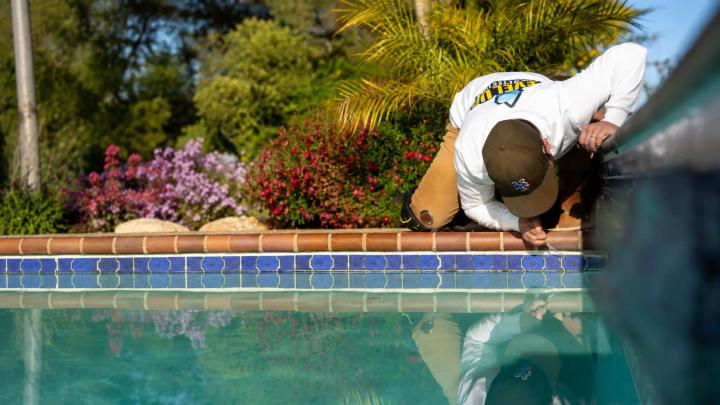
- Inspect the pool shell. We dye test cracks, the skimmer, return fittings, light niches, the light conduit, and main drains. A small puff of dye pulls toward an opening like smoke toward a vent.
- Listen for it. We use electronic listening devices to locate leaks underground. A hydrophone listens underwater. A ground microphone listens through the deck and soil for hissing water in underground PVC.
- Mark it and explain it. You get the exact leak location and a clear repair plan. Good diagnostics end with an answer, not a maybe.
- Pressure test only when needed. Pressure testing is our last resort, not our first move. If listening and dye can't pin a line down, we plug that line and pressurize it on its own. More often, we use a pressure test after the repair to prove the line holds.
This is non-invasive leak detection. No draining, no digging to "see what's there." Every Level Up tech uses LeakTronics equipment to locate leaks with precision. Want a closer look at the tools? Read how dye testing works, and when we use pressure testing.
Signs You Need a Leak Detection Service in Austin
Some water loss is normal. A July heat wave can pull a lot of water out of a pool. But these signs point to a real swimming pool leak:
- You add water more than once a week, even with the autofill off.
- The pool loses more water with the pump on, or more with it off.
- You see soggy spots or sinking pavers around the pool.
- Cracks show up in the plaster, tile line, or skimmer.
- The pump sucks air, or water drips at the equipment pad.
- Your water bill shows unexplained water use.
Not sure yet? Start with the bucket test. Then compare it to our guide on Texas heat and evaporation.
Losing water you can't explain? Call our North team at (512) 357-7272 or our South team at (737) 520-4735. We'll find it, guaranteed.
Pool Leak Repair in Austin Without Tearing Up the Deck
Finding the leak is half the job. The other half is fixing it without wrecking your yard.
A lot of local pools have limestone or flagstone decks. Homeowners often ask if we can fix it without ripping up the whole patio. Most of the time, yes. Here's how we handle the common repairs:
- Cracked underground PVC: We can often line the pipe from the inside with PipePoxy. No trench across the yard.
- Structural cracks in the shell: Structural leaks need more than a patch. Torque Lock staples hold a crack shut, even when the clay keeps moving. Our gunite crack repair guide explains why patches alone fail.
- Leaking fittings and light niches: Sealed underwater in most cases, with no draining.
We fix the root cause, not just the symptom. Read more on how a pool leak gets fixed without draining, or see our pool repair services.
What Leak Detection Costs in Austin
Level Up works on a flat rate. You know the price of the leak detection before we start. No hourly meter running while we look.
Repair costs depend on what we find. A fitting is a small job. A broken line under a deck is a bigger one. You get the repair estimate after the leak detection report, so there are no surprises. For a full breakdown, see our guide to pool leak detection cost.
Does homeowners insurance cover it? Sometimes. Many policies exclude slow wear but may cover sudden damage. Call your insurer, and ask us for the written report. It helps with any claim.
How to Prep for Your Leak Detection Visit
A full leak detection visit goes faster with a little prep. Here is what helps:
- Keep the pool at its normal water level, not low.
- Turn off the autofill 24 to 48 hours before we arrive.
- Write down how much water you lose per day.
- Unlock the gate and clear access to the equipment pad.
- Tell us about any attached spa, waterfall, or past repairs.
How long does it take? Most leak detection visits take a few hours. A pool with a spa or many lines can take longer. If the fix is small, we can often handle the leak repair on the same visit.
A quick note on scope: some local companies advertise residential and commercial leak work. Our focus is the residential pool and spa. If you manage a commercial pool, call and ask first. Buying a home with a pool? We also do a full pool inspection before you close.
Serving Austin: Our North and South Teams
Our leak detection services in Austin are split between two local teams covering the Austin area. Each one knows the soil, the pools, and the neighborhoods it serves.
North Austin: (512) 357-7272. Anderson Mill, Avery Ranch, Arboretum, Crestview, Hyde Park, Mueller, Northwest Hills, River Place, Wells Branch, and The Domain. Plus Round Rock, Cedar Park, Pflugerville, Leander, Lakeway, and Steiner Ranch. Read our North Austin reviews on Google.
South Austin: (737) 520-4735. Barton Hills, Bouldin Creek, Circle C Ranch, Oak Hill, Travis Heights, Tarrytown, Westlake, and Zilker. Plus Bee Cave, Dripping Springs, Buda, Kyle, San Marcos, and Wimberley across Central Texas. Read our South Austin reviews on Google.
Older gunite pools in Tarrytown and Hyde Park fail in different ways than newer builds in Circle C or Avery Ranch. Our crews see both every week, and no Austin leak gets a cookie-cutter plan. Living in clay country? Read why pools leak more in Austin's clay soil.
Book Austin Pool Leak Detection Today
Pool owners deserve a straight answer. Level Up handles leak detection and repair for Austin homeowners, and our leak detection company is LeakTronics certified, licensed, and insured. We have done this work for over 30 years, and we guarantee we'll find your leak.
Ready to stop topping off your pool? Call North Austin at (512) 357-7272 or South Austin at (737) 520-4735. Or book pool leak detection in Austin online. We'll find it, show you where it is, and repair the leak right.