You spotted a crack in your gunite pool. A company came out, ground it down, troweled in some new plaster, and called it fixed. One Texas summer later, the crack is back in the same spot.
If that sounds familiar, you are not alone. In Austin, a gunite pool crack repair that reopens is one of the most common calls we get. The repair did not fail because the crew was lazy. It failed because the ground under your pool never stopped moving.
This guide breaks down gunite pool crack repair the way it actually works in Central Texas. You will learn how to tell a harmless crack from a serious one, why the usual patch jobs keep failing here, and the method we use to stop a structural crack for good.
Why Most Gunite Crack Repairs in Austin Fail Within a Season
Here is the part most pool companies will not tell you. Filling a crack with epoxy or skimming plaster over it is a surface fix. The crack is just the symptom. The real cause is below the shell.
Austin sits on some of the most pool-hostile ground in the country. North of town, through Round Rock, Cedar Park, and Pflugerville, the soil is expansive clay that locals call black gumbo. It swells when it rains and shrinks hard during drought. That shrink-swell cycle pushes and pulls on your pool shell all year long.
West of Interstate 35, around Lakeway, Dripping Springs, and the Hill Country, the ground turns to limestone and shallow bedrock. That brings settlement and fractures, which leave parts of the shell unsupported. Either way, the gunite is under constant stress.
So when a crew injects epoxy and the concrete keeps shifting, the epoxy lets go. It was sitting on top of the problem the whole time. Epoxy alone is basically a sticker stuck over a moving part.
"Nine times out of ten, when someone calls us about a crack that already got fixed, we are looking at an old epoxy patch sitting on a crack that never stopped moving. The patch was never the problem. The ground was."
Level Up Leak Detection, Austin team
Dealing with a crack that came back? Call Level Up Leak Detection at (866) 420-5383 or schedule online. We service pools across North and South Austin.
Cosmetic Crack or Structural Crack? How to Tell
Not every crack is an emergency. The first job is figuring out what you are actually looking at.
Cosmetic cracks live in the plaster finish only. They are thin, often shaped like a spiderweb, and they do not leak. Pros call this crazing or check cracking. It is mostly a looks issue.
Structural cracks go through the gunite shell itself. They follow a defined line, they can leak, and they get worse when the ground moves. These are the ones that need a real repair.
Here is a quick way to compare the two.
One word of caution. A thin line at the waterline can still be structural if it is leaking. The only way to know for sure is a proper pool leak detection test, which we cover next.
How We Repair a Gunite Pool Crack with Torque Lock Staples
When a crack is structural and leaking, the goal is not to hide it. The goal is to lock the shell back together so it can survive the next dry-to-wet swing.
We use the Torque Lock structural staple system, widely regarded as the most reliable fix for cracked concrete pools. Here is how a typical gunite pool crack repair goes:
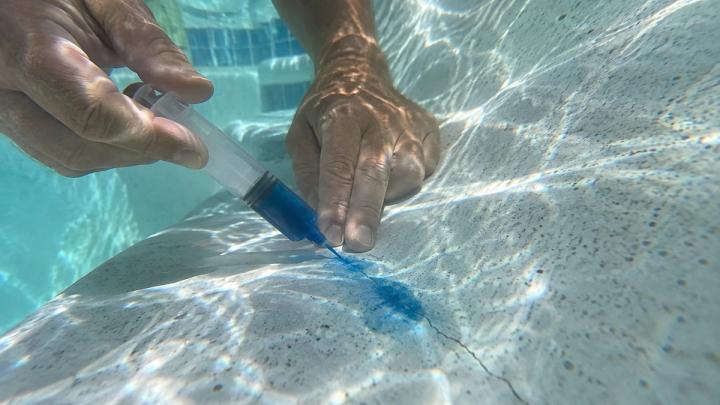
- Detect first. We confirm the crack is leaking using LeakTronics listening gear and dye testing. No staples go in until we know the crack is the real source.
- Drain and dry. Structural staple work needs a dry, clean shell, so we drain the affected area and prep the surface.
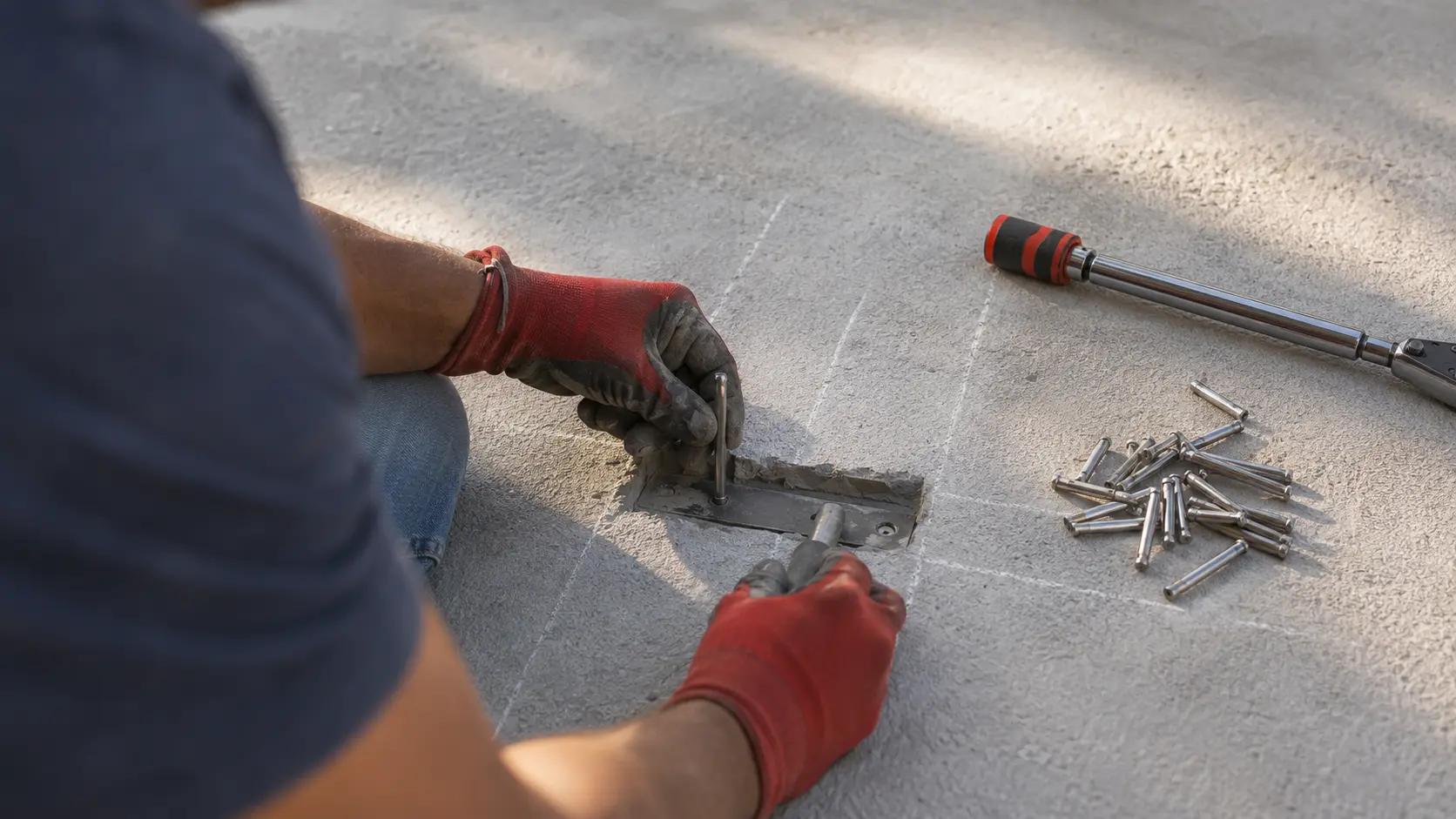
- Map the crack. We chalk the full length of the crack, including any runs that disappear into corners or steps.
- Rout and chip. We open the crack into a clean channel so the repair bonds deep, not just on the surface.
- Set the staples. Using the kit templates, we drill and install Torque Lock staples every 12 inches along the crack.
- Apply compression. Each staple uses a patented cam that torques down and pulls the two sides together with up to 5,000 pounds of compression. The crack physically cannot spread.
- Seal and finish. We pack the channel with hydraulic cement that penetrates and bonds, then refinish the surface so it blends back in.
Why does this hold when epoxy does not? Epoxy and plaster are passive. They sit there and hope the ground behaves. Rebar does not compress, and it can bend or pop out under pressure. Torque Lock staples are active. They squeeze the crack shut and keep squeezing.
"Most of the staple jobs we do are fixing somebody else's repair. The homeowner already paid once for an epoxy patch. We would rather they pay one time for the fix that actually holds."
Level Up Leak Detection, Austin team
Worried your crack is structural? Get it checked before it spreads. Call (866) 420-5383 for pool repair in Austin.
What Causes Gunite Pool Cracks in Central Texas
Cracks in Austin pools almost always trace back to the ground or to how the pool was built. The big drivers we see:
- Expansive clay (black gumbo). Common east of I-35 and across North Austin. It swells and shrinks with every wet-dry swing and drags on the shell.
- Limestone and karst ground. West of I-35 and through the Hill Country. Settlement and fractures leave parts of the pool unsupported.
- Drought, then flash flood. Central Texas does this every year. The fast jump from bone-dry to soaked is hard on concrete.
- Draining at the wrong time. An empty gunite pool in saturated ground can crack or even pop out of the ground. We almost never recommend draining without a plan.
- Build shortcuts. Thin gunite, a weak rebar layout, or cold joints from the original pour can show up as cracks years later.
This is why a crack in Buda behaves differently than a crack in Cedar Park. Same metro, different ground. Local knowledge matters here.
When to Call a Pro for a Gunite Pool Crack in Austin
Some cracks can wait for a planning conversation. Others are losing water and money right now. Call sooner rather than later if you see any of these:
- Water loss of more than a quarter inch a day that is not just summer evaporation
- A crack that is visibly getting longer or wider
- White calcium streaks trailing out of a crack
- Cracks at the steps, corners, or where the wall meets the floor
- Deck or coping cracks lining up with a crack in the shell
- A patched crack that has already reopened
Not sure if it is a leak or just the Texas heat evaporating your water? That is a common question, and a simple test settles it. If you want to read up first, our guide on the common signs of a pool leak walks through what to watch for.
Gunite Crack Repair Across North and South Austin
Level Up Leak Detection covers the whole metro with local crews and flat-rate pricing, so the quote you hear is the price you pay.
- North Austin: The Domain, Mueller, Round Rock, Cedar Park, Pflugerville, Leander, Lakeway, and Steiner Ranch. Call (512) 357-7272 or see pool repair in North Austin.
- South Austin and the Hill Country: South Congress, Zilker, Buda, Kyle, Manchaca, Dripping Springs, Wimberley, and San Marcos. Call (737) 520-4735 or visit South Austin.
Stop the Crack Before It Spreads
A gunite crack does not heal on its own, and in Austin clay it rarely stays put. The longer water runs through it, the more damage it does to the shell underneath.
Get it diagnosed by a certified team that fixes the cause, not just the surface. Call Level Up Leak Detection at (866) 420-5383, reach your local Austin crew at (512) 357-7272 in the north or (737) 520-4735 in the south, or schedule your inspection online. We will find it, and we will fix it right the first time.