Walked out to the equipment pad and found a puddle under the pump? A swimming pool pump leaking is one of the few pool leaks you can actually see with your own eyes. The trouble is, the puddle alone does not tell you much.
Where the water is coming from is what matters. A drip from the pump lid is a cheap fix you can do yourself. Water under the motor is a different story, and it can kill the pump if you ignore it.
This guide walks you through how to troubleshoot a leaking pool pump the way a pro does. You will learn the common cause behind each type of leak, which fixes are DIY, and when a pool pump leak means it is time to call for help.
First, Make Sure the Pump Is Actually the Leak
Here is something most pool owners never hear. Before you buy pump parts or a whole new pump, confirm the pump is actually the source of the leak.
We see it all the time. A homeowner spots water near the equipment pad and assumes the pump is bad. They replace it, and the puddle comes right back. The real leak was an underground line surfacing at the pad, or a plumbing fitting a foot away from the pump.
The way to know for sure is simple. Turn off the pump, dry everything on the pad completely, then watch closely as you run it and shut it back off. A leak that only drips while the pump runs points one direction. A leak that keeps going after shutoff points another. If the water is not coming from the pump at all, you have a plumbing or underground issue, and that is where real pool leak detection earns its keep.
"Nine times out of ten, when someone tells us their pump is leaking, we start by drying the whole pad and watching where the water shows back up. More often than people expect, the pump is fine. It is a cracked fitting or a line under the pad, and they were about to spend real money on the wrong part."
Level Up Leak Detection team
Not sure what you are looking at? Call Level Up Leak Detection at (866) 420-5383 or schedule online. We find the source of the leak before anyone spends a dollar on parts.
Where Is Your Swimming Pool Pump Leaking From?
Your pool pump has two basic zones. The wet end is the front half that moves water. The motor is the back half that spins. Between them sits a shaft seal that keeps water out of the motor.
Most leaks start at one of a handful of spots. Use the table below to match where you see water to the likely cause and the usual fix.
The Shaft Seal: The Leak That Can Destroy Your Pump
If water is dripping from under the center of the pump, near the spot where the wet end meets the motor, you are likely looking at a leaking shaft seal. This one deserves your attention today, not next weekend.
The shaft seal (also called the mechanical seal) rides on the motor shaft and sits at the seal plate between the wet end and the motor. Its whole job is to keep water on the water side. When that seal leak starts, water sneaks past it and heads straight for the motor bearings.
Once water gets inside the motor, the damage to the pump gets expensive fast. You may hear unusual noises from the bearings, or see rust streaks near the motor. Left alone, a cheap seal turns into a dead motor.
Fixing it means you turn off the pump, take the wet end apart, pull the impeller, and install a replacement seal. It is doable for a handy owner, but most people call a pool professional because getting the seal seated right is fiddly, and any water already inside the motor may mean you need to replace more than just the seal.
Water pooling under the motor is a real cause for concern. Get it looked at before it takes the whole pump with it. Call (866) 420-5383 for fast help.
Easy Fixes: Pump Lid, Strainer Basket, and O-Rings
Good news: many pump leaks are simple. Leaks from the pump lid are the most common cause of a dripping pump, and most owners can handle them.
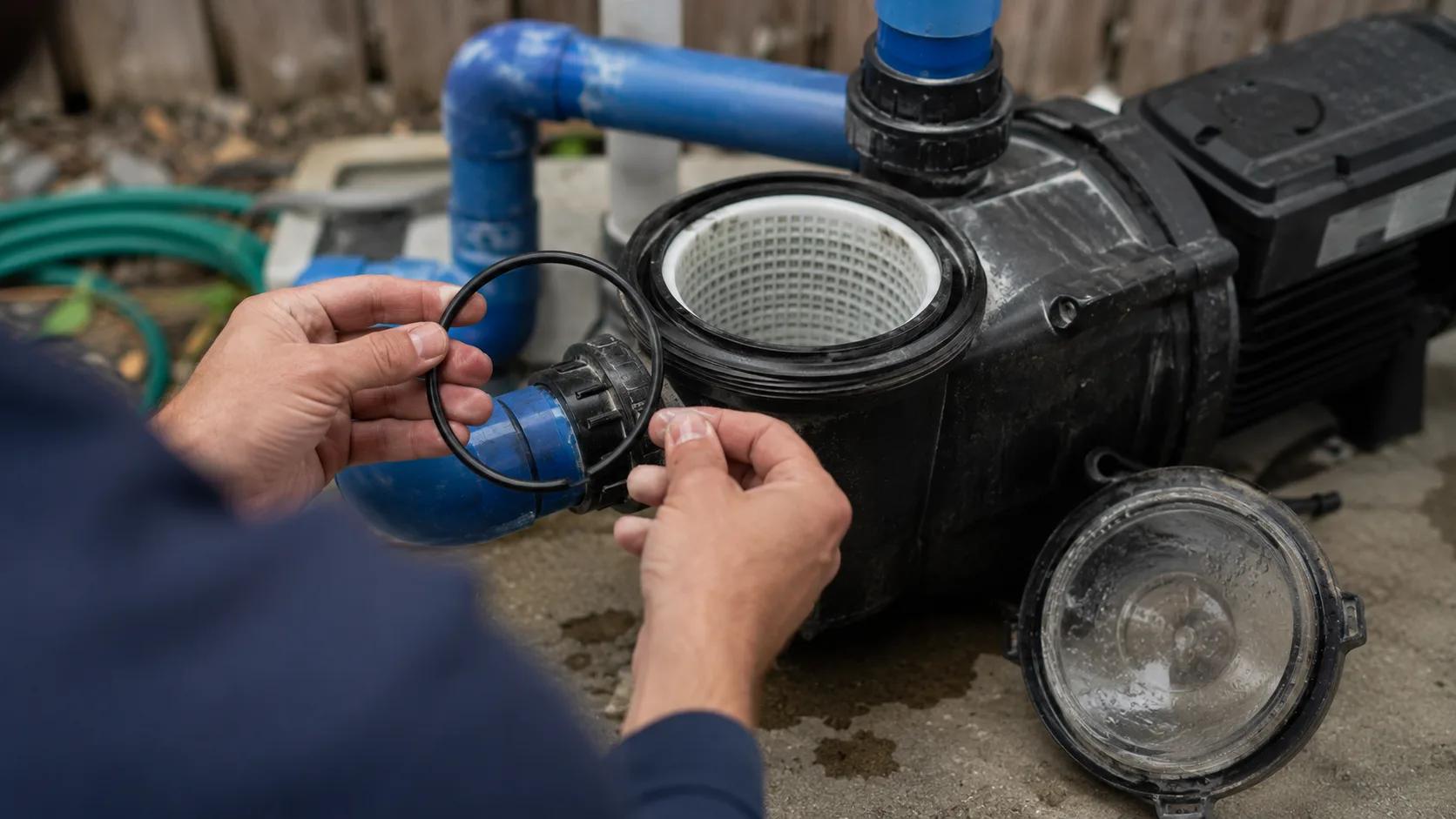
The lid o-ring on the strainer cover dries out, flattens, or picks up grit over time. When it can no longer seal, water weeps out from under the lid or the pump starts sucking air. Here is the DIY fix:
- Turn off the pump and open the air relief valve on the pool filter to release pressure.
- Remove the lid and pull the o-ring off the strainer basket housing.
- Wipe the o-ring and the seat clean. Check for cracks or flat spots.
- Coat it with a silicone-based lubricant. Never use petroleum jelly, since it breaks rubber down.
- If the o-ring is cracked or stretched, replace it. A bad o-ring is a couple of dollars.
The same idea covers the drain plugs at the bottom of the housing. Worn plug o-rings drip, so swap them and hand-tighten. For threaded plumbing connections, wrap the threads with teflon tape or a pool-rated thread sealant. Do not use silicone lube on threads. Silicone is for the o-ring or gasket, tape is for the threads.
If you clean and lubricate the seal and the pump lid still leaks, the sealing surface may be damaged. That is your sign to move up to a fresh gasket or a call to a pro.
Air Leak or Water Leak? How to Tell the Difference
Not every pump problem drips. Some leaks pull air in instead of pushing water out, and knowing the difference tells you where to look.
The suction side runs from the pool to the front of the pump, and it is under vacuum while the pump runs. A leak here does not drip when running. It sucks air. You will see bubbles in the pump basket, weak water flow, or air coming back through the return jets. Low water pressure on the gauge is another clue.
The pressure side runs from the pump through the filter and back to the pool. A leak here sprays or drips water while the pump runs. A leaking shaft seal drips no matter what.
Whether it is a Hayward, a Pentair, or any other brand, the layout is the same. Find the zone first, then the exact spot.
When to Call a Pool Professional
Plenty of pump leaks are weekend jobs. Some are not. Call a pool professional if you notice any of these:
- Water dripping from under the motor (a shaft seal is failing)
- A cracked pump housing or a leak from the pump body
- A leak you simply cannot locate on the pad
- Your pool water level dropping faster than normal
- Rising water bills with no obvious reason
- Unusual noises from the pump motor
- You replaced the o-rings and it still leaks
That last one matters. If you have done the easy fixes and water is still leaking, the problem is deeper than a lid o-ring. Chasing it with more parts usually just adds cost and potential damage.
This is also where a leak detection company is worth the call. We inspect the whole system, confirm whether the pump or the plumbing is at fault, and handle the pool repair once we know the real source. No guesswork, no replacing good pump parts.
Pool Pump Leak Help Across Our Service Areas
Level Up Leak Detection serves pools and spas in growing markets across the country. Every territory runs flat-rate pricing, so the quote you hear is the price you pay. Find your local team:
- Colorado (Littleton): (720) 783-5380, view territory
- Columbus, OH: (380) 220-6760, view territory
- North Atlanta, GA: (678) 336-8647, view territory
- North Austin, TX: (512) 357-7272, view territory
- Pasco County, FL: (727) 513-2525, view territory
- South Austin, TX: (737) 520-4735, view territory
- West Las Vegas, NV: (725) 425-5708, view territory
Not sure if we cover your zip code? Give us a call and we will point you the right way.
Stop Chasing the Wrong Leak
A leaking pool pump does not have to mean a new pump. Most of the time it is an o-ring, a fitting, or a seal. Sometimes it is not the pump at all. The trick is finding the real source before you start swapping parts.
Let a certified team pinpoint it for you. Call Level Up Leak Detection at (866) 420-5383, find your local territory, or schedule an inspection online. We will find it, and we will fix it right the first time.